Semester
Subject
Year
Tribhuwan University
Institute of Science and Technology
2081
Bachelor Level / Third Year / Fifth Semester / Science
Bachelors in Information Technology (BIT302)
(Software Engineering)
Full Marks: 60
Pass Marks: 24
Time: 3 Hours
Candidates are required to give their answers in their own words as for as practicable.
The figures in the margin indicate full marks.
Section A
Long Answers Questions
Attempt any TWO questions.
[2*10=20]
Prototyping Process Model for Software Development
Prototyping Model is a software development approach where a working prototype (an early approximate version) of the system is built, tested, and refined based on user feedback until the final product meets the requirements.
Why Prototyping?
- Used when requirements are not clearly understood at the beginning
- Helps developers and users visualize the system early
- Reduces misunderstanding between client and developer
- Allows early detection of errors and missing features
Neat Diagram
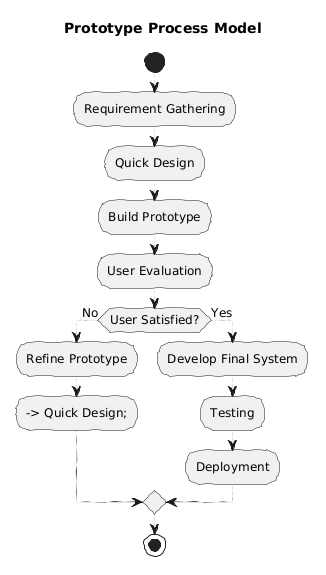
Stages of the Prototyping Model
A. Communication (Requirement Gathering)
- Developer meets the client to gather initial requirements
- A general idea of the system's scope and objectives is understood
- Complete details may not be available at this stage
B. Quick Design (Quick Plan)
- A quick design of the system is prepared focusing on aspects visible to the user (e.g., input/output formats, interface layout)
- This design is not detailed — it is just a blueprint for building the prototype
C. Modeling / Building the Prototype
- A working model (prototype) is constructed based on the quick design
- It represents only a limited functionality of the actual system
- The prototype is built quickly, not focusing on code quality or optimization
D. Deployment / Delivery to Customer
- The prototype is delivered to the customer for evaluation
- The user interacts with the prototype to understand the proposed system
E. User Evaluation & Feedback
- The customer evaluates the prototype and provides feedback
- They suggest changes, additions, or removal of features
- If the customer is not satisfied, the process loops back to Quick Design with refined requirements
- This cycle repeats until the user approves the prototype
F. Final System Development & Delivery
- Once the prototype is approved, the final system is engineered with proper coding standards, testing, and documentation
- The final product is delivered with full functionality, performance, and quality
Advantages
- Better requirement understanding through user involvement
- Reduces risk of building the wrong system
- Quick feedback helps in early error detection
- Useful for systems with unclear or changing requirements
Disadvantages
- Customer may think the prototype is the final product
- Excessive iteration can delay the project
- Poor prototype code may be carried into the final system (leading to poor quality)
- Developers may make poor design decisions to build prototypes quickly
Conclusion
The Prototyping Model is ideal when customer requirements are vague or evolving. By building and refining prototypes iteratively based on user feedback, it ensures that the final product closely matches user expectations, resulting in higher customer satisfaction.
Section B
Short Answers Questions