Semester
Subject
Year
 Eli Tamang
Tribhuwan University
Institute of Science and Technology
2082
Bachelor Level / Third Year / Fifth Semester / Science
Bachelors in Information Technology (BIT304)
(Computer Graphics)
Full Marks: 60
Pass Marks: 24
Time: 3 Hours
Candidates are required to give their answers in their own words as for as practicable.
The figures in the margin indicate full marks.
Section A
Long Answers Questions
Attempt any TWO questions.
[2*10=20]
Bresenham's Circle Drawing Algorithm & DDA Line Algorithm Trace [10 marks]
Part A: Bresenham's Circle Drawing Algorithm
Bresenham's Circle Drawing Algorithm is an efficient scan-conversion method that uses only integer arithmetic to determine the closest pixel positions along a circle's circumference, exploiting the eight-way symmetry of a circle.
Key Idea:
The algorithm calculates pixels for only one-eighth of the circle (from 0° to 45°) and uses symmetry to plot the remaining seven octants simultaneously.
Eight-Way Symmetry:
For a point on the circle, the following 8 points are also on the circle:
Algorithm Steps:
- a. Input the radius and circle center
- b. Set starting point: ,
- c. Calculate initial decision parameter:
- d. At each position, check the decision parameter :
- If : Next point is and
- If : Next point is and
- e. Plot the symmetric points in all eight octants (translate by adding $x_c, y_c$)
- f. Repeat steps d–e until
Advantages:
- Uses only integer addition and subtraction — no multiplication or trigonometry
- Very fast and efficient for hardware implementation
- Produces smooth, symmetric circles
Part B: DDA Algorithm Trace — Line from (2, 2) to (6, 6)
DDA (Digital Differential Analyzer) is a line drawing algorithm that uses incremental floating-point calculations to find successive pixel positions along a line.
Given:
- Start point:
- End point:
Step-by-step Calculation:
Iteration Table:
| Step | Pixel Plotted | ||
|---|---|---|---|
| 0 | 2 | 2 | (2, 2) |
| 1 | 3 | 3 | (3, 3) |
| 2 | 4 | 4 | (4, 4) |
| 3 | 5 | 5 | (5, 5) |
| 4 | 6 | 6 | (6, 6) |
Explanation: Since the line has a slope of (45° line), both x and y increment by exactly 1 at each step, producing a perfect diagonal line.
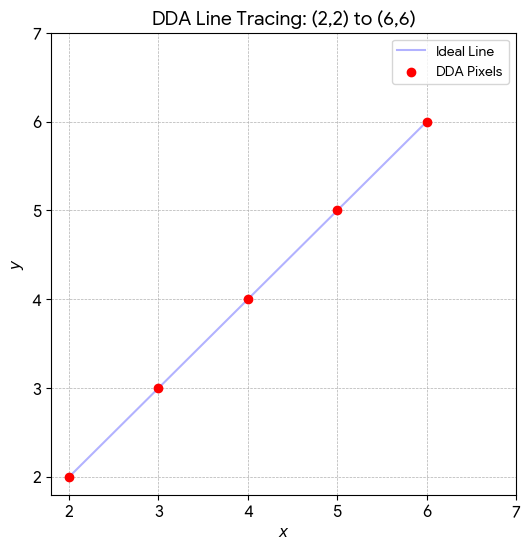
Conclusion: Bresenham's circle algorithm is preferred over parametric methods due to its integer-only arithmetic and efficiency. The DDA algorithm is simple and works well for lines of any slope by choosing the larger of dx/dy as the number of steps, ensuring smooth pixel placement.
Section B
Short Answers Questions