Semester
Subject
Year
Tribhuwan University
Institute of Science and Technology
2078
Bachelor Level / First Year / First Semester / Science
Bachelors in Information Technology (BIT101)
(Introduction to Information Technology)
Full Marks: 60
Pass Marks: 24
Time: 3 Hours
Candidates are required to give their answers in their own words as for as practicable.
The figures in the margin indicate full marks.
Section A
Long Answers Questions
Attempt any TWO questions.
[2*10=20]
Main Functions of a Digital Computer
A digital computer is an electronic device that accepts data, processes it according to instructions, and produces meaningful output.
The main functions of a digital computer are:
Input — Accepts raw data and instructions from the user through input devices (keyboard, mouse, etc.)
Storage — Stores data and instructions temporarily (primary memory) or permanently (secondary memory) for later use
Processing — Performs arithmetic and logical operations on data using the Central Processing Unit (CPU)
Output — Delivers the processed result to the user through output devices (monitor, printer, etc.)
Control — The Control Unit (CU) directs and coordinates all operations happening inside the computer
In short, a digital computer takes input, stores it, processes it, and gives output — all under the supervision of the control unit.
Block Diagram of a Digital Computer
The block diagram of a digital computer shows five key components and how data flows between them.
Components and Explanation:
Input Unit Accepts data and instructions from the user. Devices: keyboard, mouse, scanner. Converts input into binary form the computer understands.
Memory Unit (Storage)
- Primary Memory (RAM/ROM): Stores data currently being processed — fast but temporary
- Secondary Memory: Stores data permanently — hard disk, USB drives
Central Processing Unit (CPU) The brain of the computer, divided into two parts:
- ALU (Arithmetic Logic Unit): Performs all calculations (+, −, ×, ÷) and logical comparisons (AND, OR, NOT)
- CU (Control Unit): Controls and coordinates all units — it fetches, decodes, and executes instructions
Output Unit Delivers the processed result to the user. Devices: monitor, printer, speaker. Converts binary results back into human-readable form.
Block Diagram :
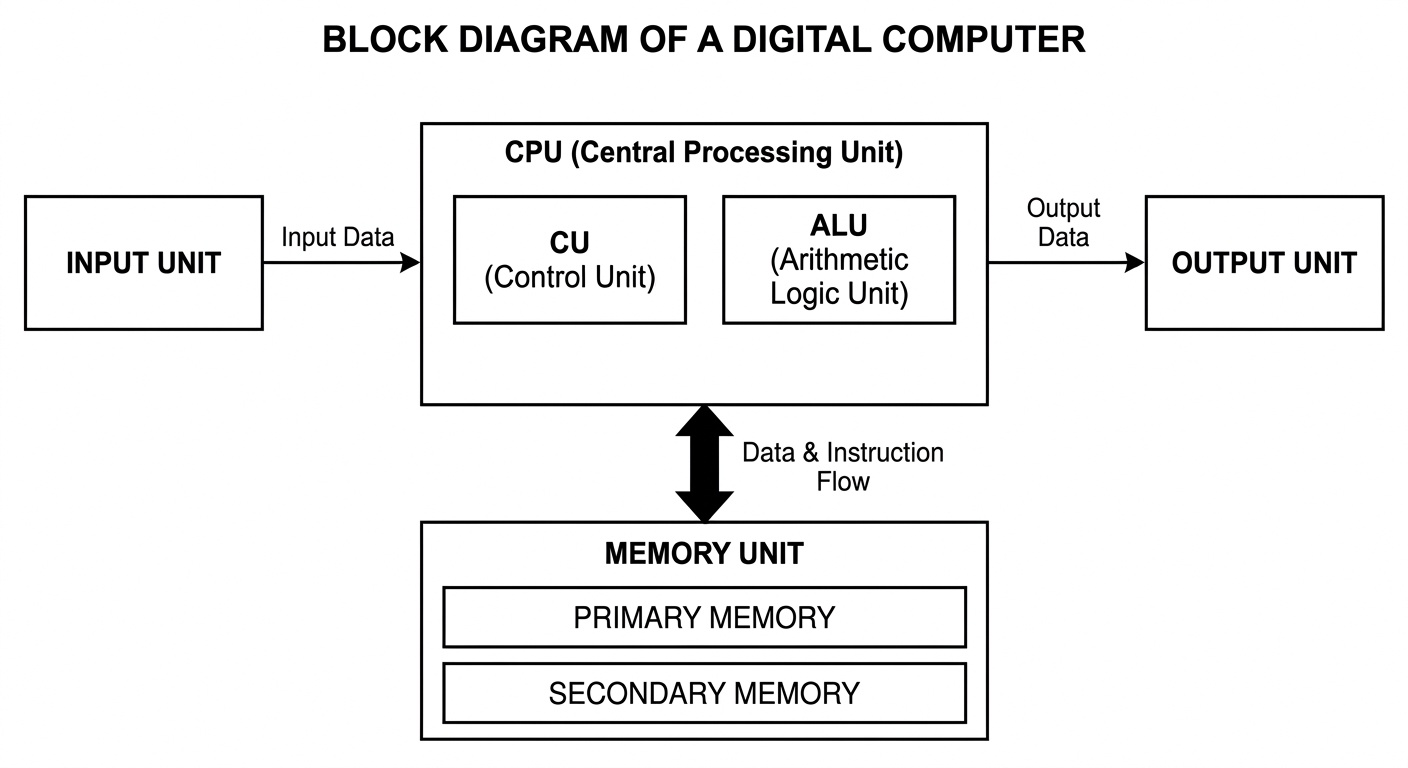
Data Flow:
- i. User gives data through the Input Unit
- ii. Data is stored in Memory
- iii. CU fetches instructions from memory and directs ALU to process data
- iv. ALU performs the required operation
- v. Result is stored back in memory and sent to the Output Unit
All five components work together in a coordinated way to complete any computing task efficiently.
Section B
Short Answers Questions