Semester
Subject
Year
Tribhuwan University
Institute of Science and Technology
2078
Bachelor Level / First Year / Second Semester / Science
Bachelors in Information Technology (BIT151)
(Microprocessor and Computer Architecture)
Full Marks: 60
Pass Marks: 24
Time: 3 Hours
Candidates are required to give their answers in their own words as for as practicable.
The figures in the margin indicate full marks.
Section A
Long Answers Questions
Attempt any TWO questions.
[2*10=20]
Components of SAP-1 Computer with Block Diagram and Comparison with SAP-2
SAP (Simple As Possible) is a simplified computer architecture designed for educational purposes to help students understand the basic concepts of how a computer works, including fetching, decoding, and executing instructions.
Block Diagram of SAP-1
The SAP-1 architecture consists of components connected via a common W-bus (8-bit bus). The data flows between components through this single bus controlled by the controller-sequencer.
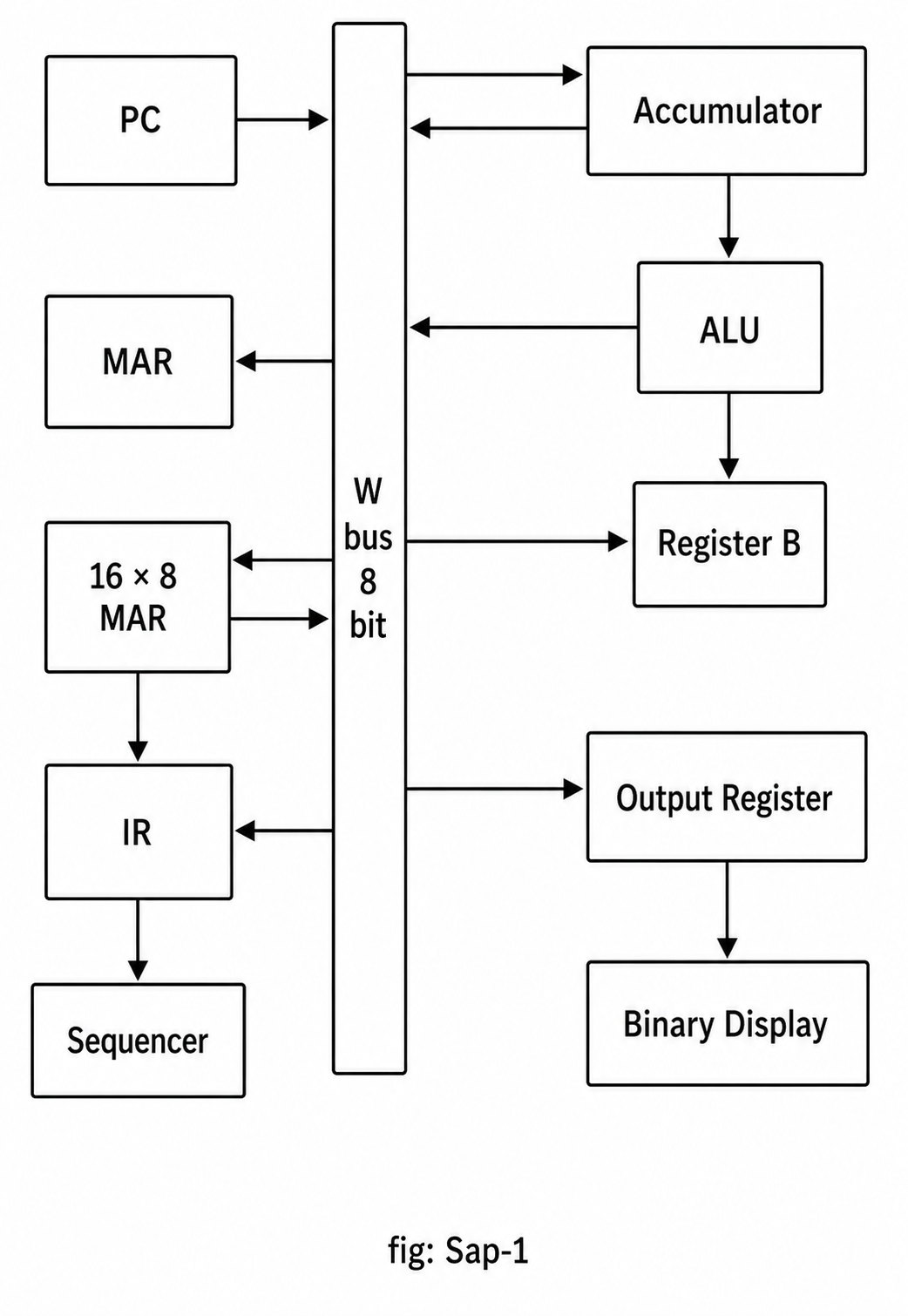
Components of SAP-1
Program Counter (PC): A 4-bit counter that stores the address of the next instruction to be fetched. It counts from 0000 to 1111 (0 to 15).
Input and MAR (Memory Address Register): A 4-bit register that receives the address from the PC and points to the memory location in RAM.
RAM (16 × 8): A 16-byte memory that stores both instructions and data. It has 16 locations, each 8 bits wide.
Instruction Register (IR): An 8-bit register that holds the current instruction. The upper 4 bits represent the opcode and lower 4 bits represent the operand (address).
Controller-Sequencer: Generates control signals (12 control bits) for all components based on the opcode. It uses a ring counter to produce timing signals (T1 to T6).
Accumulator (A): An 8-bit register that stores intermediate results of arithmetic operations. It is the main working register.
Adder/Subtractor: Performs addition and subtraction operations. It takes input from the Accumulator and B register and outputs the result.
B Register: An 8-bit register that holds the second operand for arithmetic operations.
Output Register: Stores the final result from the Accumulator and sends it to the binary display.
W-Bus: An 8-bit common bus that connects all components. Only one component can place data on the bus at a time.
Differences Between SAP-1 and SAP-2
| Feature | SAP-1 | SAP-2 |
|---|---|---|
| Bus Size | 8-bit W-bus | 16-bit address bus + 8-bit data bus |
| Instruction Set | 5 instructions (LDA, ADD, SUB, OUT, HLT) | Extended set with JMP, JNZ, JZ, CALL, RET, etc. |
| Flags | No flags | Has Sign flag and Zero flag |
| Registers | Only A and B registers | Multiple registers (A, B, C and additional registers) |
| Memory | 16 bytes (4-bit address) | 64 KB (16-bit address) |
| Addressing | Only direct addressing | Direct, indirect, and register addressing |
| I/O Capability | Only binary output display | Input port and output ports (hexadecimal) |
| Program Counter | 4-bit | 16-bit |
| Jump/Branch | Not supported | Conditional and unconditional jumps supported |
| Subroutines | Not supported | Supported with CALL and RET instructions |
Conclusion
SAP-1 is a basic introductory architecture with limited instructions and memory, designed to teach the fetch-decode-execute cycle. SAP-2 is an enhanced version that introduces flags, more registers, larger memory, and jump/subroutine capabilities, making it closer to real-world microprocessors like the Intel 8085.
Section B
Short Answers Questions