Semester
Subject
Year
 Eli Tamang
Tribhuwan University
Institute of Science and Technology
2081
Bachelor Level / First Year / First Semester / Science
Bachelors in Information Technology (BIT101)
(Introduction to Information Technology)
Full Marks: 60
Pass Marks: 24
Time: 3 Hours
Candidates are required to give their answers in their own words as for as practicable.
The figures in the margin indicate full marks.
Section A
Long Answers Questions
Attempt any TWO questions.
[2*10=20]
Components of a General-Purpose Computer with Block Diagram
A general-purpose computer is a computer designed to perform a variety of tasks based on stored programs, consisting of input, output, memory, processing, and control units.
Components of a General-Purpose Computer
A general-purpose computer consists of the following major components:
- Input Unit – Accepts data and instructions from the user (e.g., keyboard, mouse)
- Output Unit – Displays or delivers processed results to the user (e.g., monitor, printer)
- Memory Unit – Stores data and instructions temporarily (RAM) or permanently (ROM/Hard Disk)
- Central Processing Unit (CPU) – The brain of the computer, which contains:
- Arithmetic Logic Unit (ALU) – Performs arithmetic and logical operations
- Control Unit (CU) – Directs and coordinates all computer operations
- Registers – Small, fast storage locations inside the CPU (PC, IR, AC, etc.)
- Bus System – Communication pathways connecting all components (data bus, address bus, control bus)
Block Diagram of a General-Purpose Computer
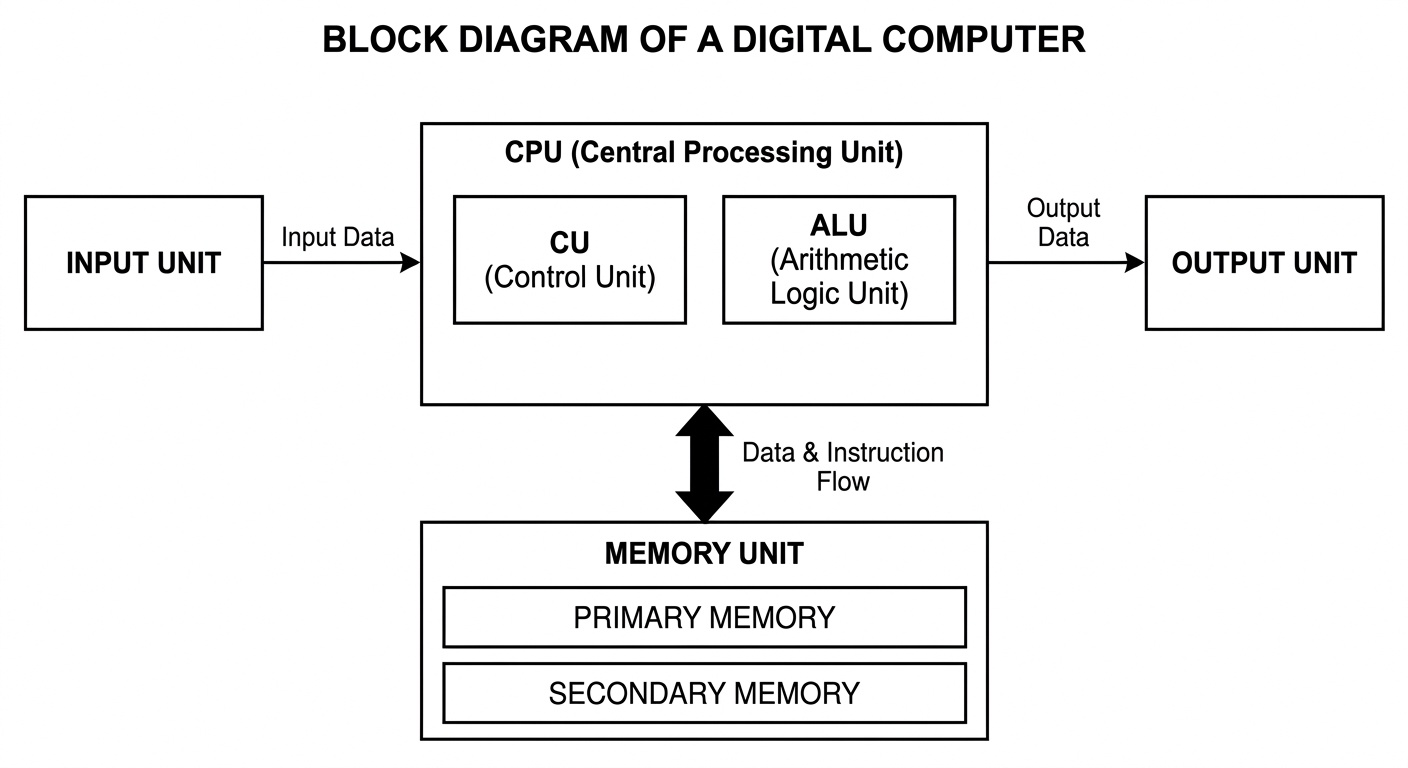
All components are connected via a system bus (Data Bus, Address Bus, Control Bus).
Functions of PC, IR, and AC Registers
a) PC – Program Counter
- PC is a register that holds the address of the next instruction to be fetched from memory.
- After each instruction is fetched, the PC is automatically incremented to point to the next instruction.
- It ensures instructions are executed in the correct sequence.
b) IR – Instruction Register
- IR is a register that holds the current instruction being executed.
- Once an instruction is fetched from memory, it is placed in the IR for decoding by the control unit.
- The control unit reads the IR to determine what operation to perform and on which operand.
c) AC – Accumulator
- AC is a general-purpose register that holds the intermediate results of arithmetic and logical operations performed by the ALU.
- It acts as a temporary storage during computation.
- Most ALU operations use the AC as both a source and destination for data.
Conclusion
A general-purpose computer works through the coordinated functioning of input, output, memory, and CPU components. Registers like PC, IR, and AC play a crucial role in the fetch-decode-execute cycle, ensuring smooth and sequential instruction processing.
Section B
Short Answers Questions