Tribhuwan University

Institute of Science and Technology

2079

Bachelor Level / First Year / First Semester / Science

Bachelors in Information Technology (MTH104)

(Basic Mathematics)

Full Marks: 60

Pass Marks: 24

Time: 3 Hours

Candidates are required to give their answers in their own words as for as practicable.

The figures in the margin indicate full marks.

Section A

Long Answers Questions

Attempt any TWO questions.
[2*10=20]
1.
If a function is defined by
f(x)={1+xif x1 x2if x>1f(x) = \begin{cases} 1 + x & \text{if } x \leq -1 \\\ x^2 & \text{if } x > -1 \end{cases}
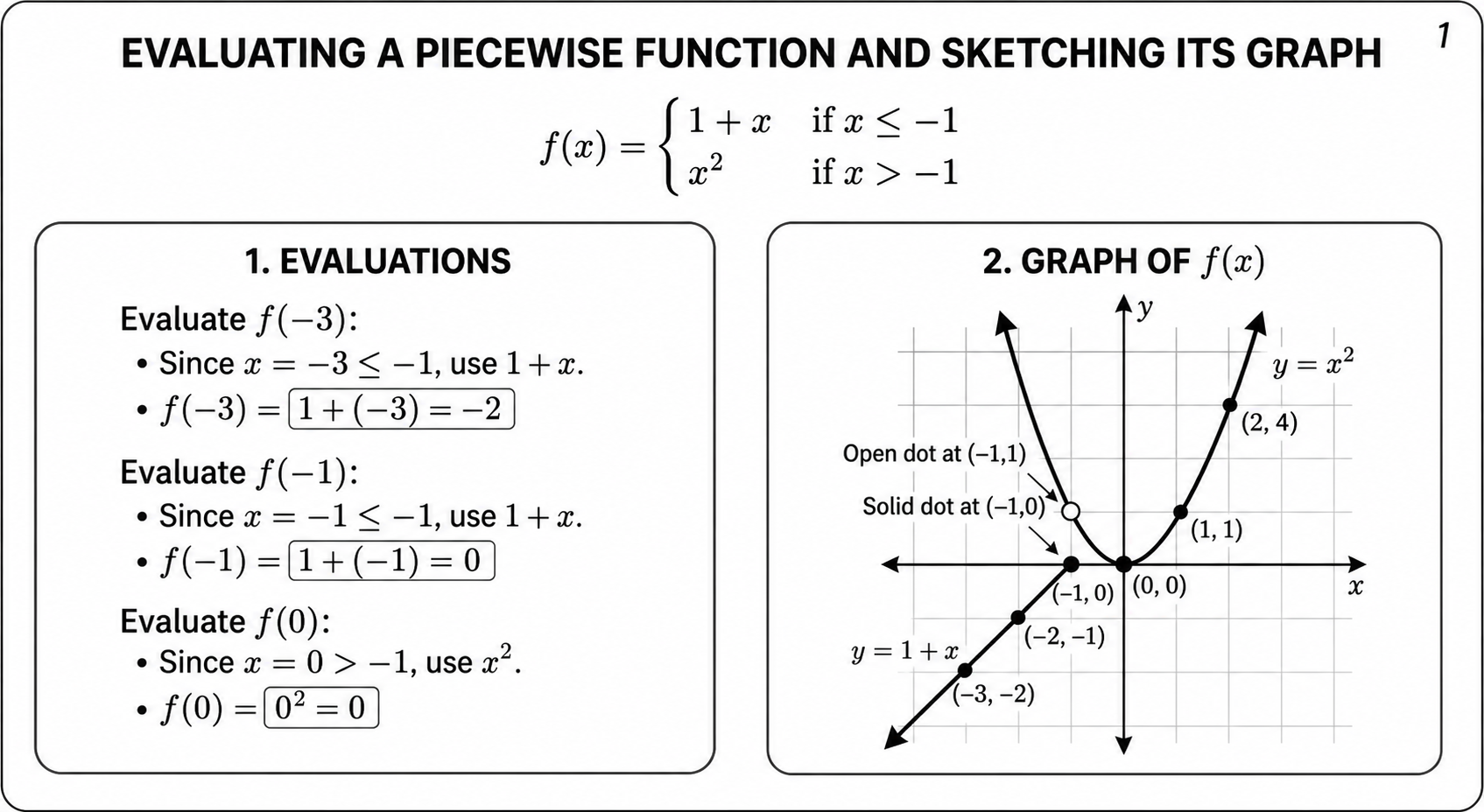
Evaluate f(3)f(-3), f(1)f(-1), and f(0)f(0) and sketch the graph.
Define different types of discontinuity at a point. At what points the function becomes continuous of the function f(x)=x2x27x+10f(x) = \frac{x-2}{x^2-7x+10}[5+5]

Main Question

A piecewise function is a function defined by different expressions for different intervals of the domain.

Evaluating the function:

Given:

f(x)={1+xif x1x2if x>1f(x) = \begin{cases} 1 + x & \text{if } x \leq -1 \\ x^2 & \text{if } x > -1 \end{cases}

a) Finding f(3)f(-3):

Since 31-3 \leq -1, we use the first piece: f(x)=1+xf(x) = 1 + x

f(3)=1+(3)=2f(-3) = 1 + (-3) = \boxed{-2}

b) Finding f(1)f(-1):

Since 11-1 \leq -1, we use the first piece: f(x)=1+xf(x) = 1 + x

f(1)=1+(1)=0f(-1) = 1 + (-1) = \boxed{0}

c) Finding f(0)f(0):

Since 0>10 > -1, we use the second piece: f(x)=x2f(x) = x^2

f(0)=(0)2=0f(0) = (0)^2 = \boxed{0}

Sketch of the Graph:

image

Second Question

Discontinuity at a point occurs when a function is not continuous at that point, i.e., limxaf(x)f(a)\lim_{x \to a} f(x) \neq f(a) or the limit does not exist.

Types of Discontinuity:

  • Removable Discontinuity: The limit limxaf(x)\lim_{x \to a} f(x) exists but is either not equal to f(a)f(a) or f(a)f(a) is not defined. The "hole" can be removed by redefining f(a)f(a).

  • Jump Discontinuity: The left-hand limit and right-hand limit both exist but are not equal, i.e., limxaf(x)limxa+f(x)\lim_{x \to a^-} f(x) \neq \lim_{x \to a^+} f(x).

  • Infinite Discontinuity: At least one of the one-sided limits tends to ±\pm\infty. This occurs at vertical asymptotes.

Analysing the given function:

f(x)=x2x27x+10f(x) = \frac{x-2}{x^2 - 7x + 10}

Step 1: Factorize the denominator:

x27x+10=(x2)(x5)x^2 - 7x + 10 = (x-2)(x-5)

Step 2: Simplify the function:

f(x)=x2(x2)(x5)=1x5,x2f(x) = \frac{x-2}{(x-2)(x-5)} = \frac{1}{x-5}, \quad x \neq 2

Step 3: Identify points of discontinuity:

The function is undefined at x=2x = 2 and x=5x = 5.

At x=2x = 2 (Removable Discontinuity):

limx2f(x)=limx21x5=125=13\lim_{x \to 2} f(x) = \lim_{x \to 2} \frac{1}{x-5} = \frac{1}{2-5} = \frac{-1}{3}

The limit exists but f(2)f(2) is undefined. So this is a removable discontinuity.

At x=5x = 5 (Infinite Discontinuity):

limx51x5=±\lim_{x \to 5} \frac{1}{x-5} = \pm\infty

The function tends to infinity, so this is an infinite discontinuity (vertical asymptote).

Conclusion:

The function is discontinuous at x=2x = 2 and x=5x = 5. It is continuous for all xR{2,5}x \in \mathbb{R} \setminus \{2, 5\}, i.e., at every point except x=2x = 2 (removable) and x=5x = 5 (infinite).

2.
Define Gradient vector and directional derivative.Find the direction in which f(x,y)=x22+y22f(x, y) = \frac{x^2}{2} + \frac{y^2}{2} increases and decreases most rapidly at the point (1,1)(1,1).What is the direction of zero change in ff at (1,1)(1,1)?Derivative of f(x,y)f(x, y) at the point (1,1)(1,1) in the direction v=3i4jv = 3i - 4j.[5+2+3]
3.
Define the concavity of the function.The graph of the function is then f(x)=x44x3+10f(x) = x^4 - 4x^3 + 10. Find the intervals on which ff is increasing and on which ff is decreasing.Find where the graph of ff is concave up and where it is concave down.Find the local maximum or local minimum value of function if exist.[2+3+3+2]
Section B

Short Answers Questions

Attempt any Eight questions.
[8*5=40]
4.
Find the domain and range of the function f(x)=5x+10f(x) = \sqrt{5x + 10}. Draw the graph of the function y=x2y = x^2 shifted up by 1 unit, down by 2 units, also shift 3 units to left, and 2 units right with new position of function. [2+3]
5.
Define horizontal and vertical asymptotes. Find the appropriate asymptotes to the function: f(x)=xx2+16f(x) = x - \sqrt{x^2 + 16}. [2+3]
6.
Find the area of the region between the x-axis and the graph of f(x)=x3x22xf(x) = x^3 - x^2 - 2x, 1x21 \leq x \leq 2. [5]
7.
Define arc-length of the curve. Find the length of the curve y=(x2)23y = (\frac{x}{2})^{\frac{2}{3}} from x=0x = 0 to x=2x = 2. [1+4]
8.
Evaluate the following integral. 0π41+cosxdx\int_{0}^{\frac{\pi}{4}} \sqrt{1 + \cos x}dx,3x27x+13x,dx\int \frac{3x^2-7x+1}{3x} , dx [5]
9.
What is a first order linear differential equation? Solve the initial value problem: tdydt+2y=t3t \frac{dy}{dt} + 2y = t^3, t>0t > 0, y(2)=1y(2) = 1. [1+4]
10.
Determine whether the following series are convergence or divergence n=155n1\sum_{n=1}^{\infty} \frac{5}{5n-1}, n=01n!\sum_{n=0}^{\infty} \frac{1}{n!}. [5]
11.
What is chain rule for function w=f(x,y)w = f(x, y)? To use this rule, find the derivative of w=xyw = xy w.r.t. tt along the path x=costx = \cos t, y=sinty = \sin t. Also, find derivative of ww at t=π2t = \frac{\pi}{2}. [1+4]
12.
Find dydx\frac{dy}{dx} of the following. y2x2=cos(xy)y^2 - x^2 = \cos(xy),x2=9y2x^2 = \frac{9}{y^2}. [5]