Credit:Eli TamangEli Tamang

Tribhuwan University

Institute of Science and Technology

2081

Bachelor Level / First Year / First Semester / Science

Bachelors in Information Technology (MTH104)

(Basic Mathematics)

Full Marks: 60

Pass Marks: 24

Time: 3 Hours

Candidates are required to give their answers in their own words as for as practicable.

The figures in the margin indicate full marks.

Section A

Long Answers Questions

Attempt any TWO questions.
[2*10=20]
1.
Explain the meaning limx2f(x)=5\lim_{x \to 2} f(x) = 5. Is it possible for this statement to be true, yet f(2)=3f(2) = 3? Explain.Draw a graph of the function f(x)=x2+4f(x) = x^2 + 4 and find its domain and range.[5+5]

Main Question [5 marks]

Meaning of limx2f(x)=5\lim_{x \to 2} f(x) = 5

Definition: The statement limx2f(x)=5\lim_{x \to 2} f(x) = 5 means that as xx gets closer and closer to 2 (from both left and right sides), the value of f(x)f(x) gets closer and closer to 5, regardless of the actual value of ff at x=2x = 2.

Key Points:

  • The limit describes the behaviour of the function near the point, not at the point.
  • xx approaches 2 but never actually equals 2.
  • For every ϵ>0\epsilon > 0, there exists a δ>0\delta > 0 such that if 0<x2<δ0 < |x - 2| < \delta, then f(x)5<ϵ|f(x) - 5| < \epsilon.

Is it possible that limx2f(x)=5\lim_{x \to 2} f(x) = 5 yet f(2)=3f(2) = 3?

Yes, it is absolutely possible.

The limit of a function as x2x \to 2 does not depend on the value of the function at x=2x = 2. The limit only concerns values of f(x)f(x) when xx is near 2, not equal to 2. So the function can have a limit of 5 as xx approaches 2, while the actual value f(2)f(2) is defined as 3 (or any other number, or even undefined).

This situation occurs when there is a removable discontinuity (a hole) in the graph at x=2x = 2, where the graph approaches y=5y = 5 but the point plotted is at (2,3)(2, 3).

Conclusion: A limit at a point and the function value at that point are two independent concepts — they need not be equal.


Sub-question 1 [5 marks]

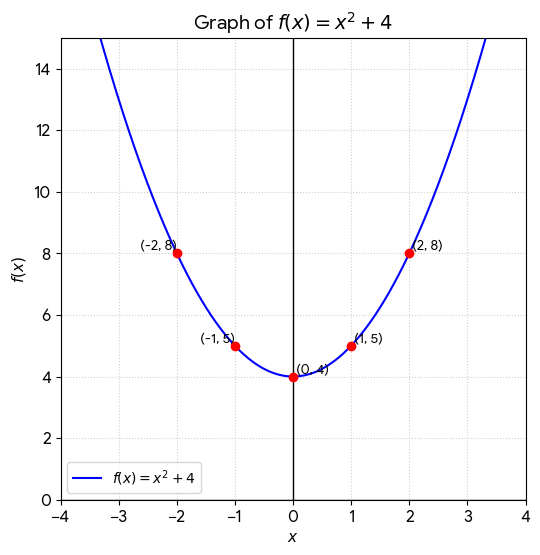
Graph, Domain, and Range of f(x)=x2+4f(x) = x^2 + 4

Definition: f(x)=x2+4f(x) = x^2 + 4 is an upward-opening parabola shifted 4 units up from the origin.

Graph Description image
Domain:

  • f(x)=x2+4f(x) = x^2 + 4 is defined for all real values of xx.

Domain=(,) or R\text{Domain} = (-\infty, \infty) \text{ or } \mathbb{R}

Range:

  • Since x20x^2 \geq 0 for all real xx, the minimum value of f(x)=x2+4f(x) = x^2 + 4 is 0+4=40 + 4 = 4.
  • The function can grow infinitely large but never goes below 4.

Range=[4,)\text{Range} = [4, \infty)

Conclusion: f(x)=x2+4f(x) = x^2 + 4 is a continuous parabola with vertex at (0,4)(0, 4), defined for all real numbers, with output values always greater than or equal to 4.

2.
Find the derivative of y=tan1xxy = \dfrac{\tan^{-1} x}{\sqrt{x}} with respect to xx.Find the area of the region bounded by y=xy = -x and x=y2+3yx = y^2 + 3y.[5+5]
3.
What is initial value problem?Find the solution of the initial value problem xdydxy=x2x \dfrac{dy}{dx} - y = x^2, y(2)=5y(2) = 5.Evaluate: limx3x25x+25x2+8x+7\lim_{x \to \infty} \dfrac{3x^2 - 5x + 2}{5x^2 + 8x + 7}.[1+4+5]
Section B

Short Answers Questions

Attempt any Eight questions.
[8*5=40]
4.
Evaluate: 4x2dx\int \sqrt{4 - x^2} \, dx. [5]
5.
Find the volume of the solid obtained by rotating about the y-axis the region bounded by y=xy = x and y=x2y = x^2. [5]
6.
Evaluate: 05dxx2\int_0^5 \dfrac{dx}{\sqrt{x - 2}}, if it exists. [5]
7.
Test whether the series n=22n21\sum_{n=2}^{\infty} \dfrac{2}{n^2 - 1} converges or diverges. [5]
8.
Use Newton's method to find 104\sqrt[4]{10} correct to four decimal places. [5]
9.
Find the partial derivatives fxf_x, fyf_y and fxyf_{xy} of f(x,y)=xy3+x4yf(x,y) = \sqrt{x} y^3 + x^4 y at (4,1)(-4,1). [5]
10.
Verify mean value theorem for the function f(x)=x2+3x+1f(x) = x^2 + 3x + 1 in [1,1][-1,1]. [5]
11.
Test whether the function f(x)={x22xx2,x21,x=2f(x) = \begin{cases} \dfrac{x^2 - 2x}{x - 2}, & x \ne 2 \\ 1, & x = 2 \end{cases} is continuous or discontinuous at x=2x = 2. Explain. [5]
12.
Evaluate: 0πxsinxdx\int_0^{\pi} x \sin x \, dx. [5]