Semester
Subject
Year
Tribhuwan University
Institute of Science and Technology
2076
Bachelor Level / Third Year / Fifth Semester / Science
B.Sc in Computer Science and Information Technology (CSC325)
(Design and Analysis of Algorithms)
Full Marks: 60
Pass Marks: 24
Time: 3 Hours
Candidates are required to give their answers in their own words as for as practicable.
The figures in the margin indicate full marks.
Section A
Long Answers Questions
Attempt any TWO questions.
[2*10=20]
Complexity of an Algorithm and Asymptotic Notations
Complexity of an algorithm is a measure of the amount of time and/or space (memory) required by an algorithm as a function of the input size .
What is Algorithm Complexity?
Algorithm complexity describes how the resource usage (time or space) of an algorithm grows as the input size increases. It helps us compare algorithms and choose the most efficient one.
- Time Complexity — the number of basic operations performed as a function of input size
- Space Complexity — the amount of memory used as a function of input size
We express complexity using asymptotic notations, which describe the behavior of a function for large values of (i.e., as $n \to \infty$).
Asymptotic Notations
There are three main asymptotic notations:
A. Big-O Notation (O) — Upper Bound
Big-O gives the worst-case (upper bound) of an algorithm's growth rate.
Definition: A function if there exist positive constants and such that:
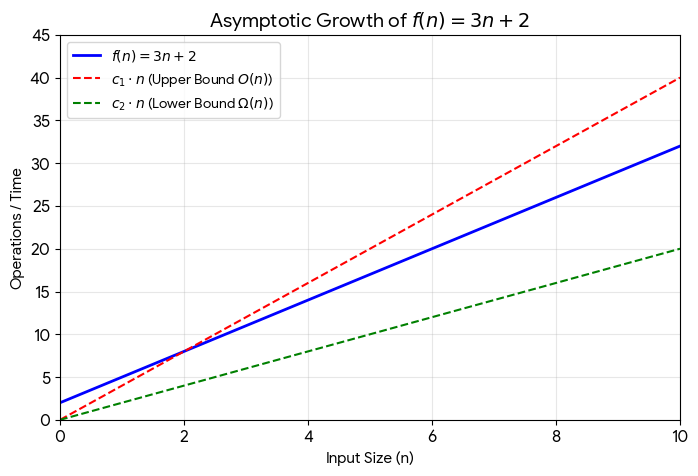
Geometrical Interpretation: The graph of lies on or below the graph of for all values beyond . It acts as a ceiling on the growth.
Example: If , then because for and : $3n + 2 \leq 4n$ for all
B. Big-Omega Notation (Ω) — Lower Bound
Big-Omega gives the best-case (lower bound) of an algorithm's growth rate.
Definition: A function if there exist positive constants and such that:
Geometrical Interpretation: The graph of lies on or above the graph of for all values beyond . It acts as a floor on the growth.
Example: If , then because for and : $3n + 2 \geq 3n$ for all
C. Big-Theta Notation (Θ) — Tight Bound
Big-Theta gives the exact/tight bound — the function grows at the same rate as .
Definition: A function if there exist positive constants , , and such that:
Geometrical Interpretation: The graph of is sandwiched between and for all values beyond . The function is bounded both above and below.
Example: If , then because for , , and : $3n \leq 3n + 2 \leq 4n$ for all
Summary Table
| Notation | Bound Type | Meaning | Symbol |
|---|---|---|---|
| Upper Bound | Ceiling | ||
| Lower Bound | Floor | ||
| Tight Bound | Sandwich |
Geometrical Diagram
Imagine a graph with on the x-axis and on the y-axis:
Conclusion
Asymptotic notations provide a mathematical framework to classify algorithms based on their efficiency. Big-O is most commonly used in practice to describe worst-case performance, while Big-Theta gives the most precise characterization of an algorithm's complexity.
Section B
Short Answers Questions