Semester
Subject
Year
Tribhuwan University
Institute of Science and Technology
2082
Bachelor Level / Third Year / Fifth Semester / Science
B.Sc in Computer Science and Information Technology (CSC325)
(Design and Analysis of Algorithms)
Full Marks: 60
Pass Marks: 24
Time: 3 Hours
Candidates are required to give their answers in their own words as for as practicable.
The figures in the margin indicate full marks.
Section A
Long Answers Questions
Attempt any TWO questions.
[2*10=20]
How do you define optimal solution? Does greedy algorithm always guarantee optimal solution? Huffman Tree Construction
Part A: Definition of Optimal Solution
An optimal solution is the best possible solution to a problem that maximizes or minimizes the objective function while satisfying all given constraints.
- It is the solution with the lowest cost, shortest path, maximum profit, or best outcome depending on the problem.
- Among all feasible solutions, the optimal solution is the one that gives the most efficient result.
Part B: Does Greedy Algorithm Always Guarantee Optimal Solution?
No, a greedy algorithm does not always guarantee an optimal solution.
- A greedy algorithm makes locally optimal choices at each step, hoping to reach a globally optimal solution.
- It works optimally only for problems that exhibit:
- Greedy Choice Property — a locally optimal choice leads to a globally optimal solution
- Optimal Substructure — an optimal solution contains optimal solutions to subproblems
Cases where greedy gives optimal solution:
- Huffman Coding
- Fractional Knapsack
- Minimum Spanning Tree (Kruskal's, Prim's)
- Activity Selection Problem
Cases where greedy FAILS to give optimal solution:
- 0/1 Knapsack Problem
- Travelling Salesman Problem
Part C: Huffman Tree for "SUPER DUPER CSIT"
Step i: Calculate Frequency of each character
String: S U P E R D U P E R C S I T
| Character | Frequency |
|---|---|
| S | 2 |
| U | 2 |
| P | 2 |
| E | 2 |
| R | 2 |
| (space) | 2 |
| D | 1 |
| C | 1 |
| I | 1 |
| T | 1 |
Total characters = 16
Step ii: Build the Huffman Tree using Greedy approach
The greedy strategy is: always pick two nodes with the smallest frequencies and merge them.
a. Pick D(1) and C(1) → merge → new node DC(2)
b. Pick I(1) and T(1) → merge → new node IT(2)
c. Now all nodes have frequency 2: S(2), U(2), P(2), E(2), R(2), Space(2), DC(2), IT(2)
d. Pick S(2) and U(2) → merge → SU(4)
e. Pick P(2) and E(2) → merge → PE(4)
f. Pick R(2) and Space(2) → merge → R_(4)
g. Pick DC(2) and IT(2) → merge → DCIT(4)
h. Pick SU(4) and PE(4) → merge → SUPE(8)
i. Pick R_(4) and DCIT(4) → merge → R_DCIT(8)
j. Pick SUPE(8) and R_DCIT(8) → merge → Root(16)
Step iii: Final Huffman Tree Structure
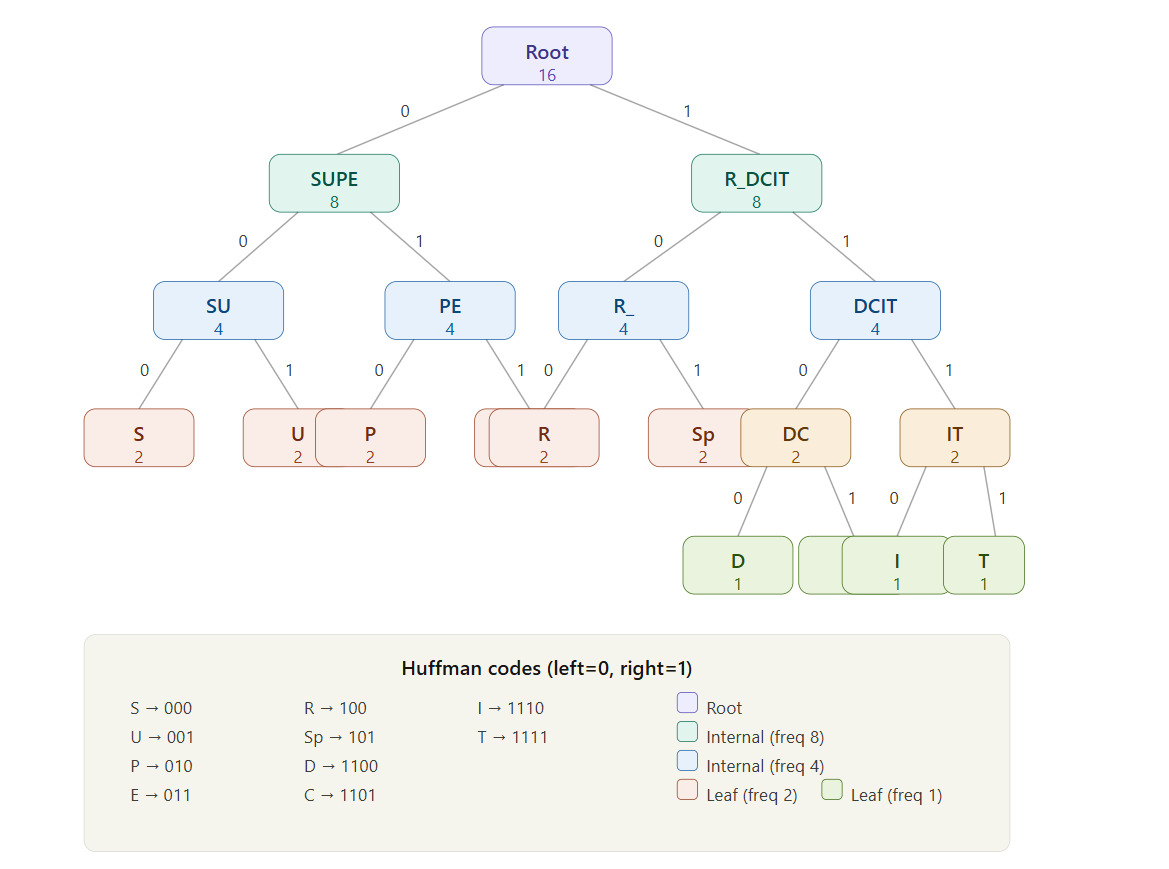
Step iv: Assign Huffman Codes (Left = 0, Right = 1)
| Character | Code | Bits |
|---|---|---|
| S | 000 | 3 |
| U | 001 | 3 |
| P | 010 | 3 |
| E | 011 | 3 |
| R | 100 | 3 |
| Space | 101 | 3 |
| D | 1100 | 4 |
| C | 1101 | 4 |
| I | 1110 | 4 |
| T | 1111 | 4 |
Step v: Calculate Total Bits
Conclusion
The Huffman coding algorithm is a perfect example where the greedy approach guarantees an optimal solution — it produces the minimum weighted path length (prefix-free code) for data compression. However, greedy algorithms do not guarantee optimality for all problems.
Section B
Short Answers Questions
Attempt any Eight questions.
[8*5=40]