Semester
Subject
Year
Tribhuwan University
Institute of Science and Technology
2081
Bachelor Level / Third Year / Fifth Semester / Science
B.Sc in Computer Science and Information Technology (CSC325)
(Design and Analysis of Algorithms)
Full Marks: 60
Pass Marks: 24
Time: 3 Hours
Candidates are required to give their answers in their own words as for as practicable.
The figures in the margin indicate full marks.
Section A
Long Answers Questions
Attempt any TWO questions.
[2*10=20]
Part A: Difference between Dynamic Programming and Memoization
| Aspect | Dynamic Programming (DP) | Memoization |
|---|---|---|
| Approach | Bottom-up approach | Top-down approach |
| Direction | Solves smaller subproblems first, builds up to larger ones | Starts from the main problem, breaks down recursively |
| Table Filling | Fills the entire table iteratively | Fills table entries only when needed (on demand) |
| Recursion | No recursion; uses iteration (loops) | Uses recursion with caching |
| Efficiency | May solve subproblems that are not needed | Solves only required subproblems |
| Space | Uses a table/array (iterative) | Uses a table/array + recursion stack |
| Control | Programmer controls the order of computation | Order determined by recursive calls |
| Overhead | No function call overhead | Has recursive function call overhead |
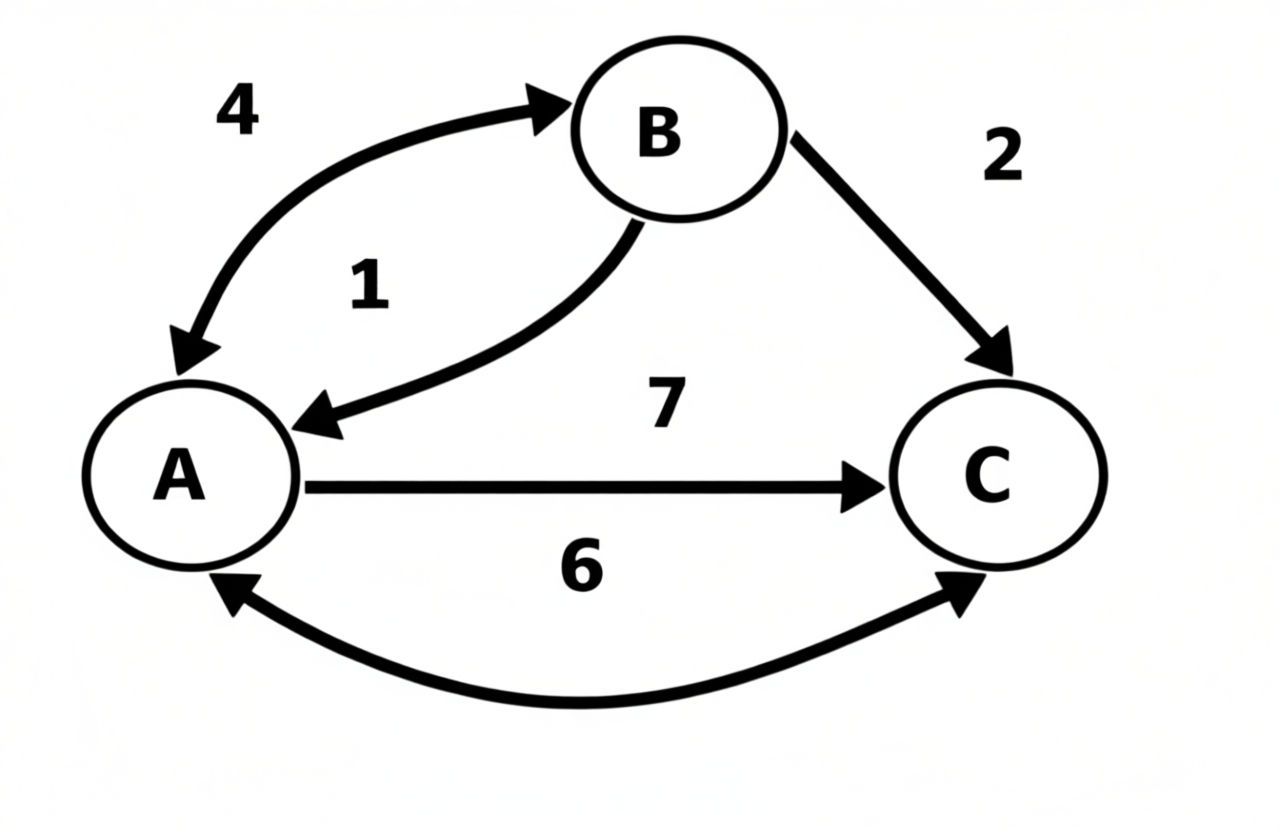
Part B: Floyd-Warshall Algorithm — Shortest Path Between Every Pair
Edges from the graph:
- A → B = 4
- B → A = 1
- B → C = 2
- A → C = 7
- C → A = 6
Initial Distance Matrix ($D^0$):
Using nodes: A, B, C (indexed as 1, 2, 3)
Floyd-Warshall Formula:
Iteration k = 1 (Intermediate vertex: A)
For each pair (i, j), check if going through A is shorter:
- (no change)
- (no change)
Iteration k = 2 (Intermediate vertex: B)
- (no change)
- (no change)
Iteration k = 3 (Intermediate vertex: C)
- (no change)
- (no change)
Final Shortest Path Matrix
| From\To | A | B | C |
|---|---|---|---|
| A | 0 | 4 | 6 |
| B | 1 | 0 | 2 |
| C | 6 | 10 | 0 |
Conclusion: The Floyd-Warshall algorithm computes all-pairs shortest paths in time using dynamic programming by systematically considering each vertex as an intermediate node.
Section B
Short Answers Questions